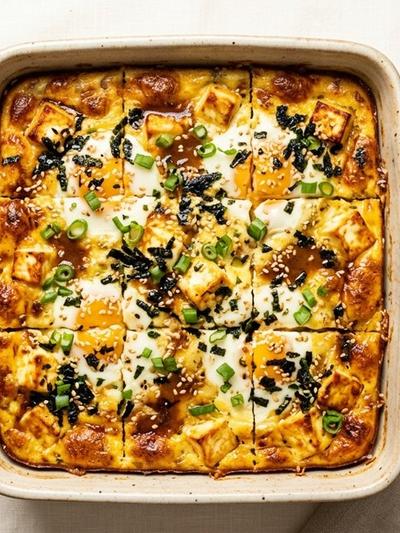
Imagine slicing into a thick wedge of frittata that smells like a Thai kitchen: fragrant lemongrass and galangal from real green curry paste, a rich coconut cream custard holding it all together, and a crust of bubbly golden mozzarella scattered with toasted sesame seeds. Each bite delivers that unmistakable Thai warmth — a little heat from the green chilies, a backdrop of sweet basil, a squeeze of fresh lime to wake everything up. This is not a timid breakfast. It is the kind of bold, satisfying morning meal that makes you forget you are eating low-carb.
The macro split here is textbook ketogenic. Full-fat coconut cream and cream cheese form the custard base, pushing the fat content to 35 grams per serving while keeping net carbs at a mere 4 grams. Eight whole eggs contribute 21 grams of protein per portion, well into the high-protein range that keeps you full until lunch without even thinking about snacking. At 75 percent of calories from fat, this frittata hits the sweet spot that makes keto actually work.
The real beauty is the batch-prep angle. You spend 40 minutes on a Sunday evening, and you have four generous portions ready for the week. Grab a slice from the fridge each morning, microwave it for 90 seconds, and you are out the door with a proper hot breakfast. It reheats beautifully — the coconut cream custard stays creamy rather than turning rubbery the way lean egg bakes often do.
Ingredients (serves 4)
For the frittata:
- 8 large eggs
- 1/2 cup (120ml) full-fat coconut cream
- 2 tablespoons vegetarian Thai green curry paste
- 2 oz (56g) cream cheese, softened and cut into small pieces
- 1 tablespoon toasted sesame oil
- 1 tablespoon tamari (gluten-free soy sauce)
- 4 oz (113g) shredded mozzarella, divided
- 2 cups (60g) baby spinach, roughly chopped
- 3 scallions, thinly sliced (white and green parts separated)
- 1 tablespoon coconut oil, for greasing
For the topping:
- 2 tablespoons toasted white sesame seeds
- Fresh Thai basil leaves (or regular basil)
- 1 lime, cut into wedges
Instructions
Preheat the oven to 375°F (190°C). Grease an 8×8-inch (20×20cm) baking dish generously with the coconut oil. Position a rack in the center of the oven.
Build the custard base. In a large bowl, whisk together the eggs, coconut cream, green curry paste, sesame oil, and tamari until the curry paste is fully dissolved and the mixture is a uniform pale green. Add the cream cheese pieces and whisk vigorously until mostly smooth — a few small lumps are fine as they will melt in the oven.
Add the fillings. Fold in the chopped baby spinach, the white parts of the scallions, and about three-quarters of the shredded mozzarella. The spinach will look like a lot, but it wilts down to almost nothing during baking.
Pour into the prepared dish. Give the mixture one final stir, then pour it evenly into the greased baking dish. Tap the dish gently on the counter to release any large air bubbles.
Add the top layer. Scatter the remaining mozzarella across the surface, then sprinkle the toasted sesame seeds evenly over the cheese. The sesame seeds toast further in the oven and create a nutty, golden crust.
Bake for 28 to 30 minutes until the center is just set — it should jiggle very slightly when you shake the dish, like a custard rather than liquid. The edges will be puffed and golden, and the mozzarella on top should be melted and starting to brown in spots. If the top is not golden enough, switch to broil for 60 to 90 seconds, watching closely.
Rest before cutting. Remove from the oven and let the frittata cool in the dish for at least 10 minutes. It will deflate slightly as it cools — that is normal and actually helps it set into a sliceable texture. Scatter the scallion greens and a few torn Thai basil leaves over the top.
Slice and serve or store. Cut into 4 equal portions. Serve warm with lime wedges for squeezing over each slice. For meal prep, let the frittata cool completely to room temperature before cutting. Transfer each portion to an airtight container and refrigerate for up to 5 days.
To reheat: Microwave a single portion on medium power for 60 to 90 seconds until warmed through. Alternatively, reheat in a 350°F (175°C) oven for 8 to 10 minutes for a crispier texture. Add a fresh squeeze of lime and a few basil leaves after reheating for the brightest flavor.
Nutrition per Serving
| Nutrient | Amount |
|---|---|
| Calories | ~419 kcal |
| Fat | ~35g |
| Protein | ~21g |
| Total Carbs | ~5g |
| Fiber | ~1g |
| Net Carbs | ~4g |
Nutritional values are approximate and may vary based on specific brands of coconut cream and curry paste used.
Tips & Variations
Choose your curry paste carefully. Many Thai green curry pastes contain shrimp paste, which is not vegetarian. Look for brands explicitly labeled vegetarian or vegan — Mae Ploy, Mekhala, and Thai Taste all make shrimp-free versions. Check the ingredient list every time you buy a new jar, as formulations can change between product lines from the same brand.
Boost the fat even higher. If you are tracking macros tightly and want to push fat content further, dollop an extra tablespoon of coconut cream on top of each reheated portion, or drizzle with additional sesame oil before eating. A tablespoon of coconut cream adds about 50 calories and 5 grams of fat with virtually zero carbs.
Watch for hidden carbs in store-bought curry paste. Some brands add sugar or starch as fillers, which can sneak an extra 2 to 3 grams of carbs per tablespoon into your breakfast. Read the label and aim for a paste with under 3 grams of carbs per tablespoon. If your preferred paste runs higher, simply reduce the amount to 1.5 tablespoons and add a pinch of ground coriander and cumin to compensate for the lost flavor.
Swap the greens to match the season. Baby spinach works year-round because it is mild and wilts completely into the custard. But chopped bok choy, thinly sliced napa cabbage, or a handful of watercress all work beautifully and keep the Asian flavor profile intact. Avoid kale or chard — their tougher texture does not meld well into the soft custard.
Double the batch for a full five-day supply. Use a 9×13-inch (23×33cm) baking dish and double every ingredient. Increase the bake time to 35 to 40 minutes, checking the center with a gentle jiggle test. This yields 8 generous portions — enough for a weekday breakfast with a spare slice or two for a quick lunch.