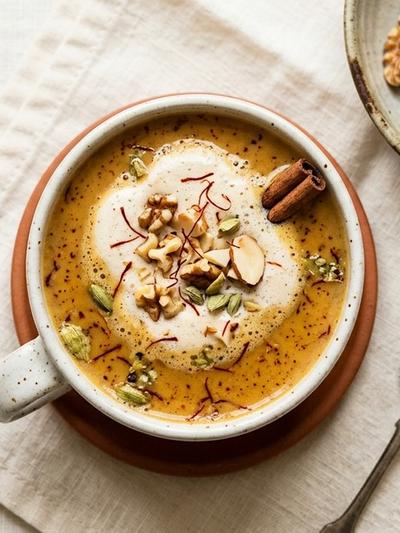
Thandai is one of India's most celebrated cold drinks — a fragrant, spiced nut milk traditionally served during Holi and Maha Shivaratri. This keto version preserves every bit of that intoxicating aroma — saffron threads blooming in warm cream, cracked cardamom, a whisper of rose water — while swapping sugar for erythritol and building the base from toasted almonds, hemp hearts, and chia seeds. The result is a silky, pale-gold drink that tastes deeply indulgent and unmistakably Indian.
What makes thandai naturally keto-friendly is that the traditional recipe already relies on ground nuts and cream for its signature richness. Each chilled serving delivers roughly 34 grams of fat from almonds, hemp hearts, poppy seeds, and heavy cream, while landing at just 2 grams of net carbs. With 8 grams of protein per glass, this is a satisfying drink that supports ketosis without a single artificial ingredient carrying the flavor.
The best part is the batch-prep design. You will make a concentrated thandai paste from toasted nuts, seeds, and freshly ground spices, then blend it with almond milk and cream into a pitcher that keeps beautifully in the refrigerator for up to five days. Each morning — or whenever the craving strikes — you simply pour, stir, and enjoy. It is equally wonderful served ice-cold on warm afternoons or gently warmed in a saucepan on cooler evenings.
Ingredients (serves 4)
For the thandai nut-and-seed paste:
- 1/2 cup (70g) raw blanched almonds
- 2 tablespoons (20g) hemp hearts
- 1 tablespoon (12g) chia seeds
- 1 tablespoon (9g) white poppy seeds (khus khus)
- 6 green cardamom pods, seeds removed and husks discarded
- 1/2 teaspoon fennel seeds
- 8 whole black peppercorns
- Generous pinch of saffron threads, about 20 strands
For the thandai milk:
- 3 cups (720ml) unsweetened almond milk
- 3/4 cup (180ml) heavy whipping cream
- 2 tablespoons rose water
- 3 tablespoons granulated erythritol or monk fruit sweetener, or to taste
- 1 tablespoon MCT oil or melted virgin coconut oil (optional, for extra fat)
- Pinch of fine sea salt
For garnish (optional):
- Crushed raw pistachios
- Dried rose petals
- Extra saffron threads
Instructions
Toast the almonds and seeds. Place the blanched almonds, hemp hearts, poppy seeds, and fennel seeds in a dry skillet over medium-low heat. Toast for 4 to 5 minutes, stirring frequently, until the almonds turn pale gold and the kitchen smells nutty and fragrant. Transfer immediately to a plate to cool for 5 minutes. Do not skip toasting — it deepens the flavor of the final drink dramatically.
Bloom the saffron. While the nuts cool, warm 2 tablespoons of the heavy cream in a small bowl in the microwave for 15 seconds (or in a tiny saucepan). Drop the saffron threads into the warm cream, stir once, and set aside. The cream will turn a vivid golden-orange as the saffron releases its color and perfume.
Grind the paste. Add the cooled toasted almonds, hemp hearts, poppy seeds, and fennel seeds to a high-speed blender or spice grinder. Add the cardamom seeds and black peppercorns. Pulse until you have a fine, slightly oily powder — about 30 to 45 seconds in a high-speed blender. Scrape down the sides as needed. You want a texture similar to almond flour; small flecks are fine and add pleasant body to the drink.
Add the chia seeds. Toss the chia seeds into the blender with the nut-seed powder. Pulse briefly, just 5 to 10 times, to partially crack the chia seeds. You want them broken but not fully ground — this lets them release their gel while still contributing a subtle texture.
Blend the full batch. Pour the unsweetened almond milk, remaining heavy cream, saffron-infused cream, rose water, sweetener, MCT oil (if using), and salt into the blender with the nut-seed mixture. Blend on high for 60 to 90 seconds until completely smooth and frothy. Taste and adjust sweetness — thandai should be gently sweet, not aggressively so. Add more rose water by the half-teaspoon if you prefer a more floral character.
Strain (optional but recommended). For the silkiest texture, pour the blended thandai through a fine-mesh strainer or nut milk bag into a large pitcher or glass jar, pressing the solids with the back of a spoon to extract every drop of flavor. If you prefer a thicker, more rustic drink with extra fiber, skip the straining entirely — both versions are delicious.
Chill and store. Cover the pitcher tightly and refrigerate for at least 2 hours before serving. The flavors meld and deepen as it sits. The thandai will keep in the refrigerator for up to 5 days. It may naturally separate during storage — this is perfectly normal.
Serve. When ready to drink, give the pitcher a vigorous stir or quick shake. Pour over ice into glasses, or warm gently in a small saucepan over low heat if you prefer it hot (do not boil). Garnish with a sprinkle of crushed pistachios, a few dried rose petals, and an extra thread or two of saffron.
Nutrition per Serving
| Nutrient | Amount |
|---|---|
| Calories | ~355 kcal |
| Fat | ~34g |
| Protein | ~8g |
| Total Carbs | ~4g |
| Fiber | ~2g |
| Net Carbs | ~2g |
Nutrition is approximate and calculated based on the stated ingredients, including straining. Skipping straining may slightly increase fiber and protein per serving.
Tips & Variations
Store the nut paste separately for ultimate freshness. If you want maximum flexibility, store the dry toasted nut-and-seed paste in an airtight container at room temperature for up to two weeks. When you want thandai, blend one-quarter of the paste with one serving of almond milk, cream, and flavorings. This approach lets you make single servings on demand while still benefiting from batch prep.
Adjust the richness to hit your fat macros. If you need more fat in your daily plan, swap the almond milk for full-fat coconut milk (canned), which adds roughly 12 grams of fat per serving. Conversely, if you are pairing this with a fat-heavy meal, reduce the heavy cream to 2 tablespoons per serving and increase the almond milk proportionally.
Watch for hidden carbs in store-bought almond milk. Always check the label and choose unsweetened almond milk with zero grams of sugar. Some brands labeled "original" or "vanilla" contain 7 to 8 grams of sugar per cup, which would push this drink well out of keto range. Brands listing only almonds, water, and a small amount of gum or salt are your safest bet.
Try a warm "thandai chai" variation. Heat a single serving in a saucepan with half a cup of brewed black tea (unsweetened) for a fusion thandai-chai that is wonderfully comforting. The tannins in the tea complement the cardamom and fennel beautifully, and the added liquid does not meaningfully change the macros.
Make it party-ready with a keto garnish board. When serving for guests, set out small bowls of crushed pistachios, toasted coconut flakes, dried rose petals, and a dusting of ground cinnamon. Let everyone customize their glass. The visual presentation — pale gold liquid, vivid green pistachios, crimson rose petals — is genuinely stunning and makes keto entertaining effortless.