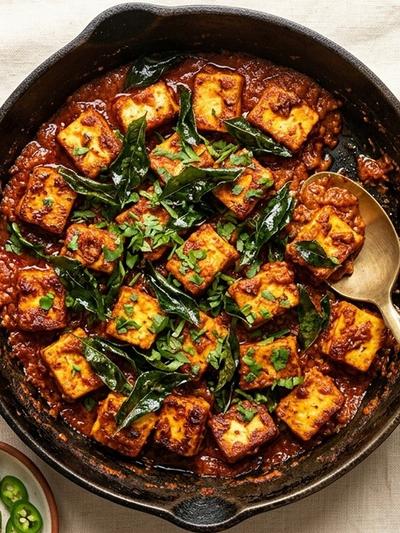
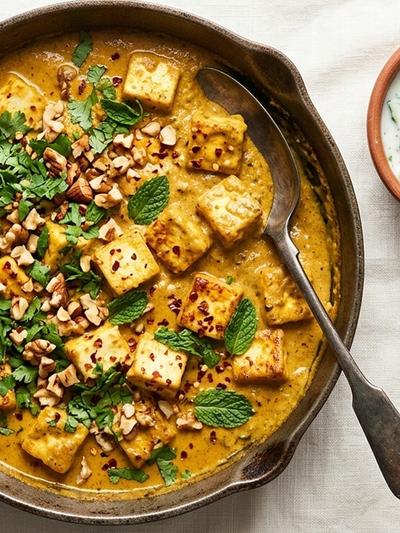
Lababdar is one of North India's most indulgent curry styles, and the name tells you everything you need to know — it translates roughly to "drenched in richness." Golden cubes of extra-firm tofu get a hard sear in ghee until they develop a delicate crust, then swim in a velvety sauce built from bloomed whole spices, slow-cooked tomatoes, and a generous pour of heavy cream finished with cold butter. The dried fenugreek leaves stirred in at the end release that unmistakable earthy, slightly bitter aroma that makes restaurant-quality Indian food so addictive. This is comfort food that hits every note: creamy, warming, subtly spiced, and deeply satisfying.
Each serving delivers roughly 50 grams of fat and only 7 grams of net carbs, making this a textbook keto dinner. The ghee and butter provide clean saturated fats, the heavy cream adds body and richness, and the tofu brings a solid 18 grams of plant-based protein without spiking your carb count. Fat accounts for over 80 percent of the calories here, so your macros stay firmly in the ketogenic sweet spot without any tricky substitutions or specialty ingredients.
The entire dish comes together in a single deep skillet in under 30 minutes, start to finish. There is no blender required — you simply mash the softened tomatoes with the back of a wooden spoon right in the pan. That means one skillet, one cutting board, and a truly impressive dinner on the table before the kitchen even has time to get messy. Serve it over cauliflower rice or alongside a few slices of keto garlic naan, and you have a weeknight meal that feels like a weekend celebration.
Ingredients (serves 4)
For the tofu:
- 2 blocks (14 oz / 400g each) extra-firm tofu, pressed and cut into 1-inch cubes
- 2 tablespoons ghee
- 1/4 teaspoon turmeric powder
- 1/4 teaspoon salt
For the lababdar sauce:
- 1 tablespoon ghee
- 1 teaspoon cumin seeds
- 2 green cardamom pods, lightly crushed
- 1 small cinnamon stick (about 1 inch / 2.5cm)
- 1 bay leaf
- 1 small onion (about 1/2 cup / 80g), finely diced
- 1 tablespoon ginger-garlic paste
- 1–2 green chilies, slit lengthwise
- 2 Roma tomatoes (about 5 oz / 140g total), finely chopped
- 1/2 teaspoon turmeric powder
- 1 teaspoon Kashmiri red chili powder
- 1/2 teaspoon ground coriander
- 3/4 cup (180ml) heavy whipping cream
- 3 tablespoons cold unsalted butter, cut into small cubes
- 1 teaspoon garam masala
- 1 tablespoon dried fenugreek leaves (kasoori methi), crushed between your palms
- Salt to taste
- Fresh cilantro leaves for garnish
Instructions
Press and prep the tofu. Drain both blocks of tofu and wrap them in a clean kitchen towel or several layers of paper towel. Place a heavy skillet or cutting board on top and press for at least 5 minutes to remove excess moisture. Cut into 1-inch cubes and pat completely dry. This step is essential for a golden, crispy sear — wet tofu will steam instead of browning.
Sear the tofu. Heat 2 tablespoons of ghee in a large, deep skillet (12-inch / 30cm works best) over medium-high heat until the ghee shimmers. Add the tofu cubes in a single layer, sprinkle with the turmeric and salt, and cook undisturbed for 2 minutes until the bottoms turn golden. Flip and continue cooking for another 2–3 minutes, turning occasionally, until golden on most sides. Transfer the tofu to a plate and set aside. Do not wipe the skillet — those browned bits are pure flavor.
Bloom the whole spices. Reduce the heat to medium and add the remaining 1 tablespoon of ghee to the same skillet. Once melted, add the cumin seeds and let them crackle for about 15 seconds until fragrant. Drop in the crushed cardamom pods, cinnamon stick, and bay leaf. Stir for 20 seconds until the spices release their aroma — you will smell warm, woodsy notes immediately.
Cook the onion base. Add the finely diced onion and cook, stirring frequently, for 3–4 minutes until the edges turn golden and the onion softens. Push the onion to one side of the pan, add the ginger-garlic paste and slit green chilies to the cleared space, and let them sizzle for 45 seconds until the raw smell disappears. Stir everything together.
Build the tomato sauce. Add the chopped Roma tomatoes, turmeric, Kashmiri red chili powder, and ground coriander. Stir well and cook for 4–5 minutes, stirring occasionally, until the tomatoes completely break down and the oil starts to separate from the masala around the edges of the pan. Using the back of a wooden spoon or a potato masher, press the tomatoes until you have a thick, chunky paste with no large pieces remaining.
Create the velvety cream sauce. Pour in the heavy cream and stir thoroughly to combine with the tomato base. The sauce will turn a beautiful sunset-orange color. Bring to a gentle simmer and cook for 2 minutes, stirring occasionally, until the sauce thickens slightly and coats the back of a spoon. Drop in the cold butter cubes one at a time, stirring after each addition until fully melted and incorporated. The cold butter emulsifies into the sauce and creates that signature lababdar silkiness.
Finish with aromatics and tofu. Sprinkle in the garam masala and crushed kasoori methi. Stir and let the fenugreek bloom in the hot sauce for 30 seconds — the fragrance will intensify dramatically. Return all the seared tofu cubes to the skillet and gently fold them into the sauce, spooning it over the top to coat every piece. Simmer together for 2–3 minutes so the tofu absorbs some of the sauce. Taste and adjust salt as needed.
Serve. Remove the bay leaf, cinnamon stick, and cardamom pods if desired. Scatter fresh cilantro leaves over the top and serve straight from the skillet. A small knob of butter melted on top at the table is entirely optional and entirely encouraged.
Nutrition per Serving
| Nutrient | Amount |
|---|---|
| Calories | ~540 kcal |
| Fat | ~50g |
| Protein | ~18g |
| Total Carbs | ~8.5g |
| Fiber | ~1.5g |
| Net Carbs | ~7g |
Approximate values calculated from 800g extra-firm tofu, 3 tablespoons ghee, 3 tablespoons butter, and 3/4 cup heavy cream across four servings.
Tips & Variations
Press the tofu thoroughly for the best sear. Excess moisture is the enemy of crispy, golden tofu. If you are short on time, slice each block into slabs, microwave between towels for 2 minutes, then cube — this removes more water faster than weight-pressing alone. The drier the tofu, the better it absorbs the ghee and develops that crackling golden exterior that holds up beautifully in the sauce.
Kashmiri red chili powder matters. Regular cayenne is significantly hotter and will overpower the sauce. Kashmiri chili powder gives lababdar its signature deep red color with a gentle, fruity warmth rather than scorching heat. If you cannot find it, substitute with a mix of 1/2 teaspoon sweet paprika and a pinch of cayenne. Avoid pre-blended "chili powder" meant for Tex-Mex cooking, which contains cumin and garlic and will throw off the flavor profile entirely.
Watch your carbs on the tomato and onion. These two ingredients carry most of the carbs in this dish, so resist the urge to add extra. Two Roma tomatoes and one small onion are enough to build a deeply flavored sauce when cooked down properly. If you want a richer sauce without more carbs, stir in an extra tablespoon of butter or a splash of cream rather than adding more vegetables.
Swap the whole spices for ground if needed. If you do not have green cardamom pods or a cinnamon stick, substitute 1/4 teaspoon ground cardamom and 1/4 teaspoon ground cinnamon, adding them with the turmeric in step 5 rather than blooming them in oil. The dish will still taste excellent, though whole spices do produce a more layered, complex flavor. Either way, kasoori methi is the one ingredient worth hunting down — it is the soul of lababdar and has no real substitute.
Store and reheat gently to preserve the sauce. Leftover lababdar keeps in an airtight container in the refrigerator for up to four days. Reheat in a covered skillet over low heat, adding a splash of cream or water to loosen the sauce as it thickens when cold. The tofu actually improves overnight as it soaks up more of the sauce. You can also freeze portions for up to two months — thaw overnight in the fridge and reheat slowly on the stovetop.