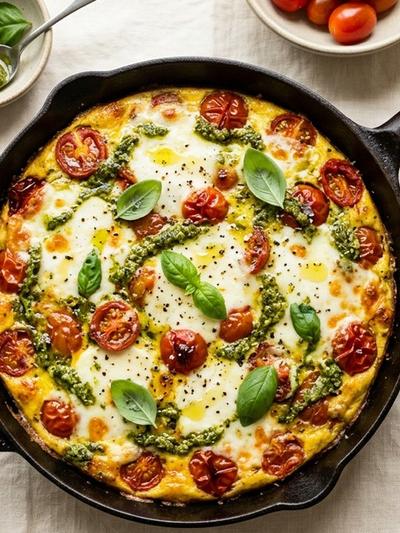
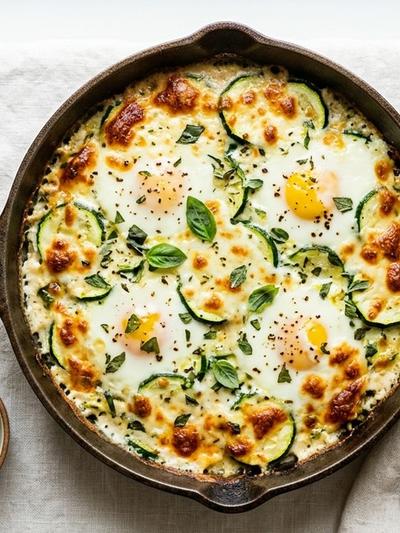
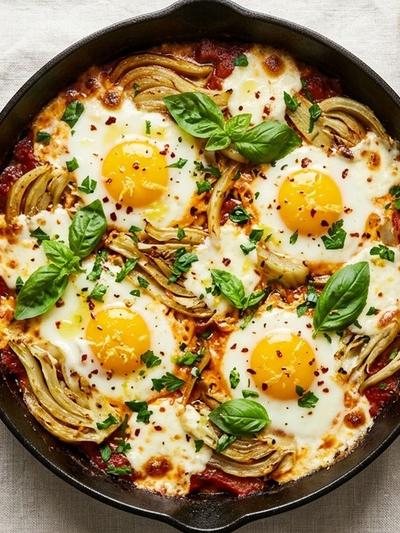
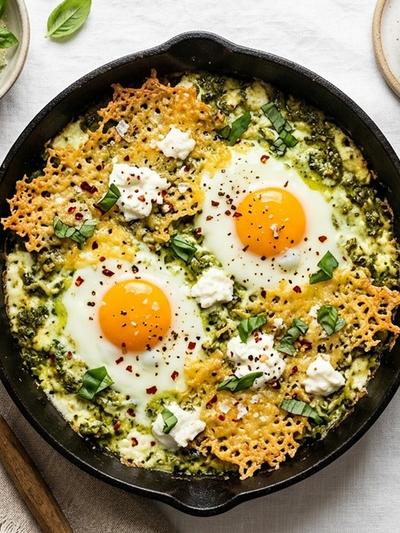
Imagine cracking eggs into a bubbling skillet of golden-edged eggplant rounds, tender zucchini ribbons, and a pool of garlicky parmesan cream that thickens around the yolks as they set to jammy perfection. This one-pan Italian breakfast is the kind of morning meal that makes you slow down, tear off a piece of keto bread, and savor every last swipe of that rich, herb-scented sauce. Fresh basil and a final shower of shaved parmesan finish the dish with the bright, aromatic flavors of a lazy Roman morning.
With roughly 55 grams of fat and only 5 grams of net carbs per serving, this skillet sits squarely in the keto sweet spot. The heavy cream and parmesan deliver most of the fat, while two eggs per serving provide a solid 30 grams of protein. There is no flour, no breadcrumbs, and no hidden sugars — just whole, honest ingredients working together.
Best of all, there is exactly one pan to wash. Everything — from searing the eggplant to baking the eggs — happens in a single oven-safe skillet in under 30 minutes. It is a weekday-friendly breakfast that feels like a weekend indulgence, and it doubles beautifully if you are cooking for company.
Ingredients (serves 2)
For the skillet base:
- 1 small eggplant, about 8 oz (225g), cut into ½-inch (1cm) rounds
- 1 small zucchini, about 5 oz (140g), halved lengthwise and sliced into half-moons
- 2 tablespoons (30ml) extra-virgin olive oil
- 2 cloves garlic, thinly sliced
- ¼ teaspoon red pepper flakes
- ½ teaspoon fine sea salt
- ¼ teaspoon freshly ground black pepper
For the parmesan cream:
- ¼ cup (60ml) heavy whipping cream
- 1½ oz (42g) finely grated Parmigiano-Reggiano, plus extra for finishing
- 1 teaspoon Italian seasoning (dried oregano, basil, and thyme blend)
For the eggs and finish:
- 4 large eggs
- 3 oz (85g) fresh mozzarella, torn into small pieces
- 6–8 fresh basil leaves
- 1 teaspoon extra-virgin olive oil, for drizzling
Instructions
Preheat your broiler. Set your oven broiler to high and position a rack about 6 inches (15cm) from the heating element. This will be used at the very end to set the egg whites and blister the mozzarella.
Sear the eggplant. Heat 2 tablespoons of olive oil in a 10-inch (25cm) oven-safe skillet over medium-high heat until the oil shimmers. Arrange the eggplant rounds in a single layer and cook without moving for 2–3 minutes until deep golden on the underside. Flip and cook for another 2 minutes. The edges should be caramelized and the flesh should be starting to turn creamy.
Add the zucchini and aromatics. Push the eggplant to one side and add the sliced zucchini to the open space. Cook for 2 minutes, stirring the zucchini occasionally, until it picks up a little color. Add the sliced garlic and red pepper flakes, stirring everything together for about 30 seconds until the garlic is fragrant but not brown. Season with salt and pepper.
Pour in the parmesan cream. Reduce the heat to medium-low. Pour the heavy cream evenly over the vegetables and sprinkle with the grated Parmigiano-Reggiano and Italian seasoning. Stir gently, letting the cream come to a lazy simmer. It will thicken within 1–2 minutes as the cheese melts into the cream and coats every piece of eggplant and zucchini.
Nestle the eggs. Using the back of a spoon, create four small wells in the vegetable mixture. Crack one egg into each well. Season the eggs with a tiny pinch of salt and pepper. Scatter the torn mozzarella pieces over and around the eggs, tucking some against the yolks.
Broil until set. Transfer the skillet to the oven and broil for 4–6 minutes, watching closely. You are looking for the whites to be fully opaque and set, the yolks to still be slightly jiggly in the center, and the mozzarella to be melted with golden-brown spots. Every broiler runs differently, so start checking at the 4-minute mark.
Finish and serve. Remove the skillet from the oven — remember, that handle is scorching hot. Drizzle with the remaining teaspoon of olive oil, scatter fresh basil leaves over the top, and finish with an extra grating of parmesan. Serve immediately, straight from the pan.
Nutrition per Serving
| Nutrient | Amount |
|---|---|
| Calories | ~648 kcal |
| Fat | ~55g |
| Protein | ~30g |
| Total Carbs | ~7g |
| Fiber | ~2g |
| Net Carbs | ~5g |
Nutrition is approximate and calculated based on the stated ingredients and serving size of 2.
Tips & Variations
Choose the right eggplant. Look for a firm, glossy eggplant that feels heavy for its size — wrinkled, spongy eggplant will absorb too much oil and turn greasy rather than silky. Italian or globe eggplant both work well here; Japanese eggplant is thinner but cooks even faster. There is no need to salt and drain the eggplant beforehand since the high-heat sear drives off moisture quickly.
Make it richer with pesto drizzle. A tablespoon of basil pesto swirled over the finished dish adds another layer of Italian flavor and extra fat. Use a store-bought pesto and check the label for added sugars or starches — most traditional oil-and-cheese pestos are naturally keto-friendly with under 1 gram of net carbs per tablespoon.
Watch hidden carbs in pre-shredded cheese. Pre-shredded parmesan and mozzarella are often coated with potato starch or cellulose to prevent clumping, adding a gram or two of hidden carbs per serving. Buy block cheese and grate or tear it yourself for the cleanest macros and better melting performance.
Swap mozzarella for burrata. If you can find fresh burrata, use it in place of the mozzarella. Tear it open and add it after broiling so the creamy stracciatella center pools into the hot sauce. Burrata is slightly higher in fat than regular mozzarella, which is a bonus on keto, and it turns the dish into something truly restaurant-worthy.
Serve with keto bread for dipping. This skillet begs for something to mop up that parmesan cream. A slice of keto 90-second bread, a wedge of almond-flour focaccia, or even a few crispy cheese crisps turn this into a fully satisfying meal. Avoid regular bread or toast, which would push the carb count well beyond keto range.