Karydopita is the walnut cake that every Greek grandmother makes a little differently, but every version shares the same soul: a dense, fragrant crumb loaded with toasted walnuts, warm cinnamon, and a whisper of cloves, all drenched in a spiced syrup that turns every forkful into something sticky, aromatic, and utterly irresistible. This keto version replaces semolina and sugar with almond flour, ground flaxseed, and erythritol, but the result is so close to the original that nobody at the table will ask where the carbs went. The combination of freshly ground walnuts, orange zest, and that warm clove-cinnamon syrup soaking into every pore of the cake creates a flavor that belongs in a seaside bakery on a Greek island.
Each serving delivers roughly 55 grams of fat from walnuts, butter, and whipped cream, with only 6 grams of net carbs. The fat-to-carb ratio sits squarely in the sweet spot for nutritional ketosis, and the 17 grams of protein from eggs, almond flour, and hemp hearts give the cake genuine substance. You get a real dessert here, not a compromise dressed up with artificial sweetness. The natural richness of the walnuts and the butter do most of the heavy lifting, and the erythritol rounds out the edges without spiking your blood sugar.
This is a batch-prep recipe by design. Bake one 8×8 pan on a Sunday afternoon, soak it in syrup, let it cool, and portion it into containers for the week ahead. The syrup-soaked cake actually improves over three to five days in the refrigerator as the spiced liquid works deeper into the crumb. Store the cinnamon whipped cream in a separate container and add a dollop when you are ready to eat. It is the kind of dessert that makes a Wednesday evening feel like a holiday, pulled straight from the fridge with zero effort.
Ingredients (serves 4)
For the walnut cake:
- ¾ cup (84g) blanched almond flour
- ¾ cup (85g) finely ground walnuts (pulse about 1 cup walnut halves)
- 2 tablespoons (14g) ground golden flaxseed
- 2 tablespoons (20g) hemp hearts
- 3 large eggs, at room temperature
- 3 tablespoons (42g) unsalted butter, melted and slightly cooled
- ⅓ cup (53g) granular erythritol or monk fruit sweetener blend
- 1½ teaspoons ground cinnamon
- ¼ teaspoon ground cloves
- Zest of 1 small orange (about 1 tablespoon)
- 1 teaspoon pure vanilla extract
- 1 teaspoon baking powder
- ¼ teaspoon fine sea salt
For the spiced syrup:
- ½ cup (120ml) water
- 3 tablespoons granular erythritol
- 1 cinnamon stick
- 2 whole cloves
- 1 tablespoon fresh lemon juice
- 1 strip of orange peel, about 2 inches (5cm) long
For the cinnamon cream:
- ½ cup (120ml) cold heavy whipping cream
- 1 tablespoon powdered erythritol
- ½ teaspoon ground cinnamon
- ½ teaspoon vanilla extract
For garnish:
- 2 tablespoons roughly chopped toasted walnuts
- 1 tablespoon hemp hearts
Instructions
Preheat the oven to 325°F (165°C). Line an 8×8-inch (20×20cm) baking pan with parchment paper, leaving an overhang on two sides for easy lifting. Lightly grease any exposed edges with butter.
Grind the walnuts. Pulse the walnut halves in a food processor in short bursts until you have a fine, sandy meal. Stop before you reach walnut butter — about 8 to 10 one-second pulses. A few slightly larger pieces are fine and add pleasant texture.
Combine the dry ingredients. In a large bowl, whisk together the almond flour, ground walnuts, ground flaxseed, hemp hearts, cinnamon, cloves, baking powder, and salt until evenly distributed.
Mix the wet ingredients. In a separate bowl, beat the eggs with the granular erythritol for about 1 minute until slightly frothy and lighter in color. Stir in the melted butter, vanilla extract, and orange zest until smooth.
Bring the batter together. Pour the wet mixture into the dry ingredients and fold with a spatula until just combined. The batter will be thick and dense, similar to a brownie batter. Do not overmix.
Bake the cake. Scrape the batter into the prepared pan and spread it evenly with the spatula. Bake for 22 to 25 minutes, until the top is golden brown, the edges have pulled slightly away from the pan, and a toothpick inserted in the center comes out with just a few moist crumbs. The cake will firm up further as it absorbs the syrup.
Make the syrup while the cake bakes. Combine the water, erythritol, cinnamon stick, whole cloves, and orange peel strip in a small saucepan over medium heat. Bring to a gentle boil, then reduce the heat to low and simmer for 8 minutes, stirring occasionally, until the liquid has reduced by about one-quarter and smells deeply aromatic. Remove the pan from the heat, stir in the lemon juice, and strain out the solids through a fine mesh sieve. The syrup should be warm and fragrant.
Soak the cake. As soon as the cake comes out of the oven, use a skewer or thin knife to poke about 20 holes evenly across the surface, pushing halfway down. Slowly pour the warm syrup over the hot cake, starting at the edges and working toward the center. The cake will sizzle and absorb the liquid within a minute or two. Let it cool completely in the pan on a wire rack, at least 1 hour. The texture improves the longer it sits.
Whip the cinnamon cream. In a chilled bowl, combine the cold heavy cream, powdered erythritol, cinnamon, and vanilla. Beat with an electric mixer on medium-high speed until stiff peaks form, about 2 to 3 minutes. Cover and refrigerate until ready to serve.
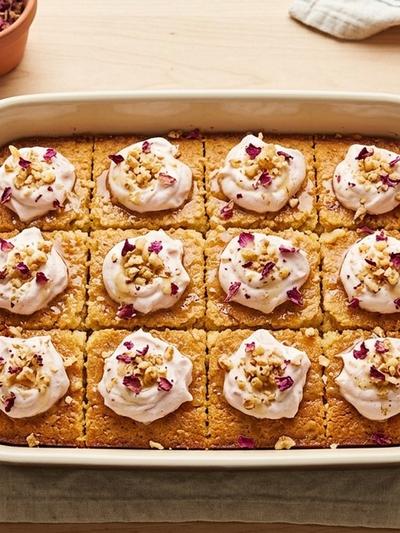
Cut and serve. Lift the cooled cake from the pan using the parchment overhang. Cut into 8 equal squares. Serve 2 squares per portion with a generous spoonful of cinnamon cream, a scatter of chopped toasted walnuts, and a pinch of hemp hearts.
Batch-prep storage. Wrap the syrup-soaked cake tightly in plastic wrap or store in an airtight container in the refrigerator. Keep the whipped cinnamon cream in a separate sealed container. The cake holds for up to 5 days and develops richer flavor by day two. Add the cream fresh when serving.
Nutrition per Serving
| Nutrient | Amount |
|---|---|
| Calories | ~570 kcal |
| Fat | ~55g |
| Protein | ~17g |
| Total Carbs | ~11g |
| Fiber | ~5g |
| Net Carbs | ~6g |
Nutritional values are approximate and based on the stated ingredients. Erythritol is excluded from carb counts as it has a glycemic index of zero.
Tips & Variations
Toast your walnuts before grinding them. Spread walnut halves on a dry sheet pan and toast at 325°F (165°C) for 6 to 8 minutes, stirring once, until they smell nutty and have deepened slightly in color. Toasting before grinding amplifies the walnut flavor dramatically and gives the cake a roasted depth that raw walnuts simply cannot match. Let them cool completely before pulsing in the food processor.
Store the cake and cream separately. The syrup-soaked cake is robust and improves in the fridge over several days, but whipped cream deflates and weeps if stored on top of moist cake. Keep the cinnamon cream in its own sealed container and spoon it on right before eating. If the cream softens after a day or two, give it a quick 30-second whip with a fork to bring it back.
Choose the right sweetener for the syrup. Erythritol can recrystallize when cooled, especially in syrups. If you notice a slightly gritty texture after refrigeration, swap to an allulose-based sweetener for the syrup only — allulose does not recrystallize and produces a smoother, more honey-like result. It counts as roughly 0.2 to 0.4 calories per gram and has minimal glycemic impact, so it will not meaningfully change the macros.
Add a splash of brandy for an authentic Greek finish. Traditional karydopita syrup often includes a tablespoon of brandy or Metaxa. Stir it into the syrup right after removing it from the heat and before straining. The alcohol cooks off against the hot cake, leaving behind a warm, complex aroma that pairs beautifully with the cloves and orange. This adds negligible carbs.
Watch out for hidden carbs in sweetener blends. Some granular erythritol products are bulked with maltodextrin or dextrose, which spike blood sugar. Read the label and choose a pure erythritol or a monk fruit-erythritol blend where the only listed ingredients are erythritol and monk fruit extract. Swerve, Besti, and Lakanto are reliable options that will not knock you out of ketosis.