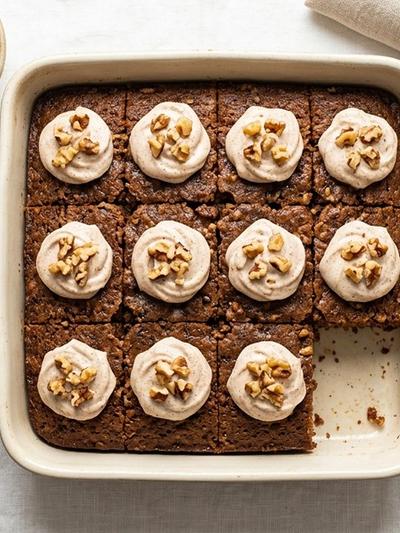
Imagine biting into a tender, crumbly square drenched in fragrant orange blossom syrup, the toasted coconut giving way to a soft, almost pudding-like center. These vegan keto basbousa squares capture everything that makes the classic Middle Eastern semolina cake so beloved — the floral sweetness, the syrup-soaked crumb, the scattering of vivid green pistachios — without a grain of sugar or a spoonful of semolina in sight. Desiccated coconut and coconut flour stand in for the traditional base, delivering that distinctive grainy bite while keeping carbs firmly in check.
Each serving clocks in at roughly 32 grams of fat and just 4 grams of net carbs, making these squares an almost ideal keto macro profile at over 80 percent fat calories. The combination of coconut oil, coconut cream, and desiccated coconut creates a rich, satisfying dessert that curbs cravings without knocking you out of ketosis. Ground flaxseed replaces eggs for binding, keeping the recipe fully plant-based while adding a small dose of omega-3 fats.
The real beauty of basbousa, though, is how well it suits batch cooking. You press the batter into a single pan, bake it once, soak it in syrup, and stash the whole tray in the fridge. The squares actually taste better after a day or two as the syrup penetrates deeper into the crumb. Make them on Sunday and you have a ready-to-grab keto dessert for every day of the workweek — no reheating required.
Ingredients (serves 4)
For the basbousa batter:
- 3/4 cup (60g) unsweetened desiccated coconut
- 1/4 cup (28g) coconut flour
- 1/4 cup (48g) granular erythritol or monk fruit sweetener
- 1/2 teaspoon ground cardamom
- 1/4 teaspoon ground cinnamon
- 1/2 teaspoon baking powder
- 1/4 teaspoon fine sea salt
- 1/4 cup (56g) coconut oil, melted and slightly cooled
- 1/3 cup (80ml) full-fat coconut cream
- 2 tablespoons (14g) ground flaxseed mixed with 5 tablespoons (75ml) warm water (2 flax eggs)
- 1 teaspoon orange blossom water
- 1/2 teaspoon pure vanilla extract
For the sugar-free orange blossom syrup:
- 3 tablespoons (36g) powdered erythritol or monk fruit sweetener
- 3 tablespoons (45ml) water
- 1 teaspoon fresh lemon juice
- 1 teaspoon orange blossom water
For the topping:
- 2 tablespoons (16g) shelled pistachios, roughly crushed
- 9 whole blanched almonds (optional, for scoring)
Instructions
Prepare the flax eggs. In a small bowl, whisk the ground flaxseed with the warm water until combined. Set aside for 10 minutes to thicken into a gel-like consistency. While you wait, preheat the oven to 325°F (165°C) and line a 6×6-inch or 8×6-inch baking dish with parchment paper, leaving overhang on two sides for easy lifting. If you only have an 8×8 pan, use that — the squares will be slightly thinner and will bake about 3 minutes faster.
Mix the dry ingredients. In a medium bowl, whisk together the desiccated coconut, coconut flour, granular sweetener, cardamom, cinnamon, baking powder, and salt until evenly combined. Break up any clumps of coconut flour with your fingers if needed.
Combine the wet ingredients. In a separate bowl, stir together the melted coconut oil, coconut cream, thickened flax eggs, orange blossom water, and vanilla extract until smooth.
Make the batter. Pour the wet mixture into the dry ingredients and fold with a spatula until a thick, slightly sticky batter forms. Coconut flour absorbs liquid aggressively, so the batter will thicken as you stir. If it feels too stiff to spread, add one more tablespoon of coconut cream.
Press into the pan. Transfer the batter to the prepared dish and press it into an even layer using damp fingers or the back of a spoon. The layer should be about 3/4-inch (2cm) thick. Score the surface into 9 squares with a knife, cutting about halfway through the batter. If using whole almonds, press one into the center of each scored square.
Bake. Place the pan in the center of the oven and bake for 25 to 28 minutes, until the top is golden and the edges have pulled away from the parchment slightly. The center should feel firm when gently pressed, not spongy. Do not overbake — basbousa dries out quickly once past the golden stage.
Make the syrup while baking. In a small saucepan over medium heat, combine the powdered sweetener, water, and lemon juice. Stir until the sweetener dissolves, then let the mixture simmer gently for 3 minutes. Remove from heat and stir in the orange blossom water. The syrup should be thin and pourable. Set aside.
Soak the basbousa. As soon as the pan comes out of the oven, re-cut along the scored lines with a sharp knife, going all the way through this time. Slowly pour the warm syrup evenly over the hot basbousa. You will hear a gentle sizzle as the syrup hits the surface — this is exactly what you want. The hot cake absorbs the syrup much better than a cooled one. Let the tray sit for at least 15 minutes to soak.
Add the topping. Scatter the crushed pistachios over the top of the squares, pressing them lightly into the surface so they stick. Allow the basbousa to cool completely in the pan, at least 30 minutes total, before lifting out by the parchment overhang.
Portion and store. Cut along the lines to separate the 9 squares. Divide into 4 portions (2 to 3 squares each). Transfer to airtight containers, separating layers with parchment if stacking. Refrigerate for up to 5 days.
Nutrition per Serving
| Nutrient | Amount |
|---|---|
| Calories | ~335 kcal |
| Fat | ~32g |
| Protein | ~4g |
| Total Carbs | ~10g |
| Fiber | ~6g |
| Net Carbs | ~4g |
Nutritional values are approximate and calculated from the stated ingredient quantities. Actual values may vary by brand.
Tips & Variations
The syrup must go on hot. This is the single most important step in basbousa. Hot syrup on a hot cake means maximum absorption and that signature moist, almost sticky interior. If the cake cools before you pour, reheat the syrup to a gentle simmer and use a skewer to poke small holes through the surface to help it penetrate.
Choose the right erythritol texture. Use granular sweetener in the batter for structure, but powdered in the syrup. Granular erythritol will not dissolve fully in a brief simmer and leaves a gritty coating. If you only have granular, blitz it in a spice grinder for 15 seconds before making the syrup. Monk fruit blends behave similarly and work as a one-to-one swap.
Orange blossom water intensity varies wildly between brands. Start with the stated 1 teaspoon in the batter and 1 teaspoon in the syrup. Taste the raw batter — if the floral note is barely there, add another half teaspoon. If your brand is particularly potent (common with Middle Eastern imports), reduce to half a teaspoon per component. Rose water makes a lovely alternative if orange blossom is hard to find, though the flavor profile shifts closer to the almond basbousa already on this site.
These squares freeze beautifully. Wrap individual squares tightly in cling film, place in a zip-top bag, and freeze for up to 6 weeks. Thaw overnight in the refrigerator. The syrup prevents the freezer-dry texture that plagues most baked goods, so they come out nearly as good as fresh.
For a richer chocolate variation, replace 2 tablespoons of the desiccated coconut with 2 tablespoons of unsweetened cocoa powder and fold in 1 tablespoon of roughly chopped 90% dark chocolate. This adds roughly 1 gram of net carbs per serving but creates a deeply indulgent Middle Eastern brownie-meets-basbousa hybrid. Omit the cardamom and lean into the cinnamon if taking this route.