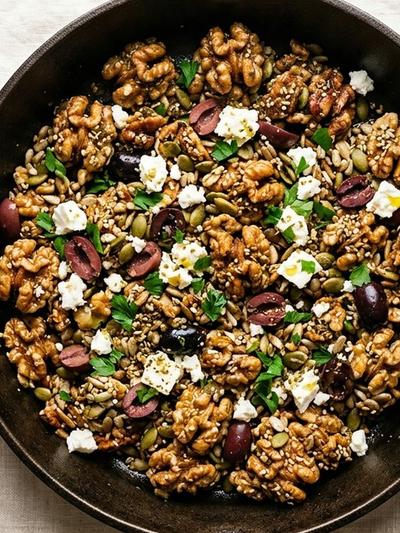
Close your eyes and picture a bowl of warm couscous, golden and fragrant with cumin and garlic, studded with salty kalamata olives and sharp crumbles of feta, brightened at the last second with a generous squeeze of lemon. Now open your eyes: this version has zero grains. The entire base is built from walnuts pulsed to a coarse, pearl-like texture, then toasted in butter and olive oil with almond flour, hemp hearts, flax, and chia seeds until every bite crackles with nutty depth. The result is richer and more satisfying than any grain couscous you have ever eaten.
Each serving delivers roughly 48 grams of fat from whole-food sources — walnuts, hemp hearts, olive oil, and butter — with only 6 grams of net carbs. The generous fiber from flax and chia keeps the net count low, while feta and hemp hearts contribute 13 grams of protein. This is exactly the kind of high-fat, ultra-low-carb side dish that makes vegetarian keto feel effortless rather than restrictive.
Everything happens in a single skillet, start to finish, in about twenty minutes. There is no oven to preheat, no blender to scrub, no second pan lurking in the sink. Serve it warm alongside grilled halloumi, a simple green salad, or roasted eggplant. It also holds beautifully at room temperature for a mezze spread, and it reheats in minutes, making it a strong candidate for weekly meal prep.
Ingredients (serves 4)
For the walnut-seed base:
- 1 cup (100g) raw walnut halves
- 1/4 cup (28g) superfine almond flour
- 3 tablespoons (30g) hemp hearts
- 2 tablespoons (20g) ground golden flaxseed
- 1 tablespoon (12g) whole chia seeds
For cooking and seasoning:
- 3 tablespoons (45ml) extra virgin olive oil
- 2 tablespoons (28g) unsalted butter
- 3 cloves garlic, minced
- 1 teaspoon ground cumin
- 1/2 teaspoon ground coriander
- 1/4 teaspoon Aleppo pepper or a pinch of red pepper flakes
- 1/2 teaspoon fine sea salt, plus more to taste
- 1/4 teaspoon freshly ground black pepper
To finish:
- 1/3 cup (45g) pitted kalamata olives, quartered lengthwise
- 2 tablespoons (30ml) fresh lemon juice (about 1 lemon)
- 1 teaspoon finely grated lemon zest
- 3 ounces (85g) crumbled feta cheese
- 1/4 cup loosely packed fresh flat-leaf parsley, roughly chopped
- 2 tablespoons fresh mint leaves, thinly sliced
Instructions
Pulse the walnuts. Add the walnut halves to a food processor and pulse five or six times, about one second per pulse, until the pieces are roughly the size of couscous grains — mostly small and uniform with a few larger bits for texture. Do not hold the button down or you will end up with walnut butter. If you do not have a food processor, place the walnuts in a sturdy zip-top bag and crush them with a rolling pin, checking frequently. Transfer the pulsed walnuts to a bowl and toss them with the almond flour, hemp hearts, ground flaxseed, and chia seeds. Set aside.
Heat the skillet. Place a large (12-inch / 30cm) skillet over medium heat. Add the olive oil and butter. Once the butter melts and begins to foam, add the minced garlic and cook for about thirty seconds, stirring constantly, until fragrant but not browned.
Toast the nut-seed mixture. Add the cumin, coriander, and Aleppo pepper to the garlic butter and stir for ten seconds to bloom the spices. Immediately pour in the entire walnut-seed mixture. Spread it into an even layer and let it toast undisturbed for about two minutes. Stir, then continue cooking for another four to five minutes, stirring every forty-five seconds or so, until the mixture turns a shade darker, smells deeply nutty, and feels dry and crumbly rather than damp. The almond flour and flax will absorb the fat as they toast, creating that characteristic couscous texture. Season with the salt and pepper.
Remove from heat and finish. Take the skillet off the burner — residual heat is all you need from here. Immediately scatter the quartered kalamata olives over the surface and squeeze the lemon juice evenly across the pan. Add the lemon zest and toss everything together with a fork, fluffing the mixture the same way you would fluff grain couscous. Taste and adjust the salt; feta is salty, so go easy here.
Add feta and herbs. Scatter the crumbled feta over the top, followed by the parsley and mint. Give it one last gentle toss — just enough to distribute the cheese and herbs without crushing them. Serve straight from the skillet while warm, or transfer to a shallow bowl for the table.
Nutrition per Serving
| Nutrient | Amount |
|---|---|
| Calories | ~505 kcal |
| Fat | ~48g |
| Protein | ~13g |
| Total Carbs | ~11g |
| Fiber | ~5g |
| Net Carbs | ~6g |
Nutrition is approximate and based on the specific ingredients and amounts listed above. Variations in brand, olive oil drizzle, or feta quantity will shift values slightly.
Tips & Variations
Nail the walnut texture. The single most important step is pulsing the walnuts correctly. You want pieces roughly the size of pearl couscous — around three to four millimeters. Pulse in short, sharp bursts and stop often to check. If a few larger chunks survive, that is fine; they add welcome texture. If you accidentally over-process a portion into paste, scrape it out and use it in a fat bomb or smoothie rather than adding it here.
Swap the nut for a different flavor profile. Pecans or macadamia nuts work in place of walnuts and keep the carb count comparable. Pecans lean slightly sweeter and pair especially well with the mint. Macadamias add a buttery richness but cost more. Avoid cashews or pistachios as your main base — their carb counts are meaningfully higher and will push net carbs above target.
Watch the hidden carbs in olives. Not all olives are equal on keto. Kalamata olives run about 1 to 2 grams of net carbs per quarter cup and add tremendous flavor for the cost. Avoid olive mixes that include sweet peppers, pickled onions, or sugar-laced marinades, as these can sneak in extra carbs. Always check the label when buying from a deli counter.
Use Aleppo pepper for authentic Mediterranean warmth. Aleppo pepper is mildly spicy with a fruity, almost sun-dried-tomato sweetness that is hard to replicate. If you cannot find it, a small pinch of regular red pepper flakes plus a tiny pinch of sweet paprika gets you in the neighborhood. Urfa biber is another Turkish option that works beautifully — it is smokier and darker, but equally low-carb.
Make it ahead for easy meal prep. The toasted walnut-seed base keeps in an airtight container in the refrigerator for up to five days. Store the feta, olives, and fresh herbs separately. When ready to serve, reheat the base in a dry skillet over medium-low heat for two to three minutes, then toss in the cold toppings — the residual warmth softens the feta just enough. This separation also prevents the herbs from wilting and the feta from turning mushy during storage.